
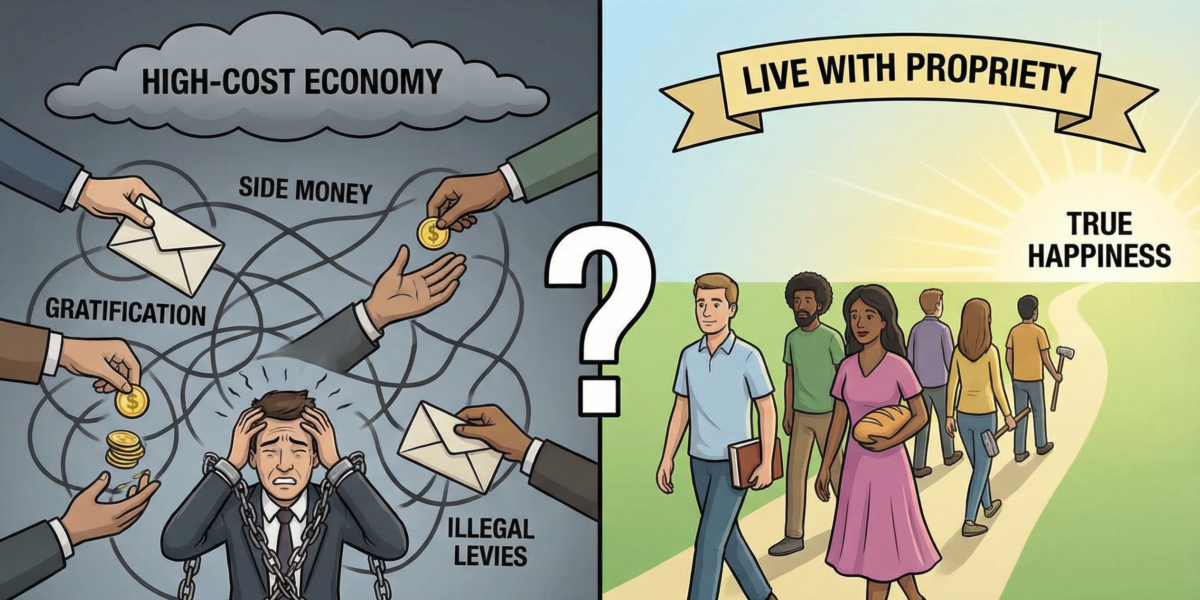
A Reflection for Those Chasing Extra Income—Regardless of How It’s Obtained
Every single day, we are bombarded with news about corruption. Not a day passes without reports of it. That’s at the “upper” levels of society. Meanwhile, for the “middle class,” there are terms like “illegal levies” and “side hustles”—extra income beyond one’s main salary. For the “lower class,” there’s what they call “side work”—casual earnings for those who already have steady jobs. But ironically, for many in the lower class, this “side work” has become their primary source of income.
***
Then there’s the practice of “redeeming”—paying unofficial fees to obtain diplomas, appointment letters, or any legal documentation that would eventually lead to earning money. People don’t care that such practices wound the principles of justice and meritocracy. They ignore the fact that dignified income should come after someone works hard, sweats, climbs the hills of struggle through legitimate paths to reach the summit—and only then receives fair compensation: income or benefits that are righteous and good.
A Sad Shift in Meaning
I used to think that terms like “side money,” “extra work,” and “redeeming” were normal things. Legitimate things. Things that didn’t violate laws or contradict societal norms. Things still within the boundaries of any religion or belief system. I thought they were simply additional income supporting someone’s main earnings—especially if done to make ends meet, particularly for those who felt they hadn’t achieved financial sufficiency yet.
But as time passed, I realized I was wrong.
A sad semantic shift has occurred. Whatever we call these practices, they’re now perceived negatively, carrying dark connotations. And truly, when we speak of what’s permissible and what’s forbidden, who dares claim that these practices remain clean and righteous? And if they’re not righteous—doesn’t that mean they’re corrupt?
Gratification: Another Name for the Same Thing
For similar practices, there’s a more formal legal term: gratification—gifts from someone expecting returns from the recipient, clearly outside the bounds of propriety. This term can legally ensnare individuals and lead to criminal prosecution.
As it turns out, there have always been many terms that essentially mean the same thing. There’s “tribute,” “gifts,” “donations,” “assistance”—which of course don’t carry their original meanings but are euphemisms for gratification. These terms are used to disguise improper activities that ultimately harm society at large.
High-Cost Economy: The Bitter Fruit We All Harvest Together
Unsurprisingly, with rampant corruption, gratification, and similar practices, the end result is a high-cost economy. Life becomes uncomfortable because there are always these extra costs we inevitably must pay.
From the moment you step just a little beyond your front door, there are already forms of extortion. Moving further—to schools, universities, any institution involving bureaucracy for services that should be our rights—there are always additional costs that don’t exist in any written regulations.
And at the highest levels of civic and national life? It’s the same story: there must always be “grease money” to smooth services that shouldn’t need lubricant to function normally.
A Sad Paradox
Strangely enough, even with all this “extra income,” does anyone actually live more comfortably? As it turns out—not really.
The problem isn’t just one or two people holding this principle—those who don’t care about the means, as long as they get more income.
The result? It’s what we witness today.
As a society, as a nation, everyone ends up suffering. No one profits. No one wins. Everyone loses. Everyone is defeated.
A high-cost economy. Almost everything is expensive compared to the general public’s purchasing power. Almost no matter can be handled through normal channels.
Yes, of course, those with excess money and power—the wealthy and powerful—can still feel they live “better” than the general population. But don’t forget: they too are always haunted by fear and anxiety—fear that someone will steal, rob, or seize their wealth. Living under pressure, having to maintain a lifestyle that increasingly demands more material wealth. Fearing that someday the law might catch up with them and send them to prison.
The middle and lower classes? They certainly suffer more. The middle class still struggles to secure primary and secondary needs. Forget about living luxuriously—even daily necessities aren’t easy to obtain. The lower class? Still grappling with the most basic needs: what will I eat tomorrow?
So What’s the Point?
So what’s the point of wanting “extra” income through corruption, gratification, seeking side money and extra work, shamelessly “redeeming” this and that—if life still doesn’t become more comfortable or easier?
We envy and want to be like developed nations. But we don’t want to walk the difficult path that their societies walked. We want shortcuts. Instant results. Everything fast, relying on connections and improper transactions.
We want the jackfruit, but refuse to deal with its sticky sap.
Questions for Ourselves
So, what do we really want in life?
Don’t we want to live safely, comfortably, and happily?
Yet what we experience day after day—for hundreds of years now—hasn’t brought us any closer to that dream.
So why are we so foolish, preserving things that are wrong? Is it because we love to justify our habits, but never habituate ourselves to justice?
A Simple Way Out
Isn’t it easier if we don’t need to make extra efforts through illegitimate means? No need for corruption, gratification, seeking side money and extra work, no need to “redeem” this and that?
Let us simply strive through proper means and be content with our earnings. True, we won’t suddenly become fabulously wealthy. Yes, perhaps life will remain as it is. But certainly: not poor. And most importantly: life becomes easier.
Even if we don’t have much extra money in hand, if all matters proceed quickly and properly, without these additional costs everywhere, with justice spread evenly throughout—isn’t that enough for us?
A Vision of True Happiness
No more need for illegitimate efforts. Just do what you already have to do as best as you can.
If everyone thought this way, there would no longer be high-cost economics, social inequality, insecurity, and injustice. Purchasing power may not increase dramatically, but if everything is affordably priced because it’s proper—without these extra costs—and if the use of money flows through its correct and proper channels, life would become easier, more comfortable, and more beautiful.
The dream of becoming a just and developed nation would no longer be impossible. That is where happiness lies.
Closing
What do we really want in life?
To live safely, peacefully, comfortably, happily—right?
So how do we get there?
As said: no need for corruption, gratification, seeking side money and extra work, no need to “redeem” this and that. Simply live this life with propriety. No need to desire “extra” income through wrong means. Just live as best as you can.
May everyone find happiness.
