When Indonesia’s most sacred word found a home on an English narrowboat
September 5, 2015. Cambrian Wharf, Birmingham.
Sweat dripped from my forehead. My lungs burned with the sweet ache of a seven-kilometer run. My New Balance shoes had carried me through the grey English morning along the towpath, past converted warehouses and sleeping ducks, past joggers and dog-walkers and the eternal stillness of canal water.
And then I saw it.
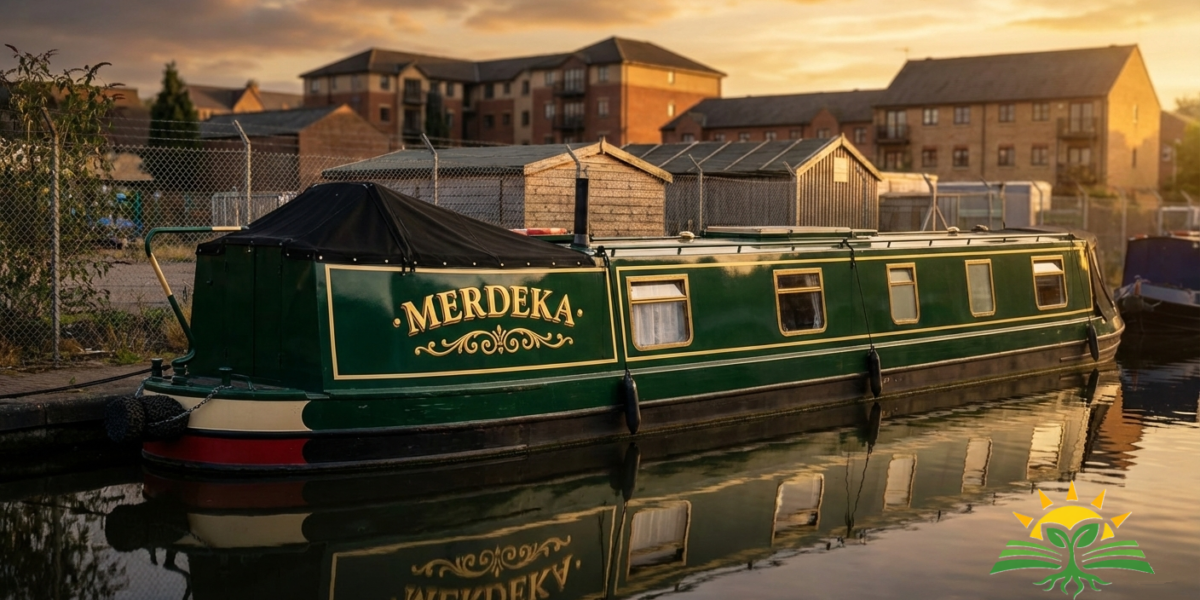
A name. Painted in elegant Victorian script on the hull of a narrowboat:
Merdeka.
The world stopped spinning for exactly three seconds.
* * *
Part I: The Weight of Seven Letters
Imagine walking through a foreign city—let’s say Kyoto, or Nairobi, or São Paulo. You know no one. You are far from everything familiar. And suddenly, in the most unexpected place, you hear someone call your name.
Not a common name. Your full name. With the correct pronunciation.
That is what I felt when I saw Merdeka on that narrowboat.
To the average English person walking by, it was probably just an exotic word. Perhaps they assumed it was Welsh, or Gaelic, or some maritime term they’d never encountered. They might have found it pleasant-sounding, rolled the syllables around in their minds for a moment, then moved on.
But to me?
To me, Merdeka was the voice of my mother waking me at 5 AM every August 17th for the flag ceremony. It was my grandmother’s trembling hands as he recounted stories of the revolution. It was schoolchildren in white and red uniforms singing songs of struggle. It was the tears I saw in my father’s eyes once, only once, when the national anthem played and he thought no one was watching.
Merdeka is not just the Indonesian word for freedom. It is the Indonesian word for us—for who we are, who we were, and who we are still becoming.
And here it was, floating on the waters of Birmingham, in the heart of a nation that once ruled a quarter of the globe.
The irony was almost too perfect.
* * *
Part II: The Anatomy of a Narrowboat Name
To understand why this moment struck me so deeply, you must first understand narrowboat culture.
A narrowboat is not merely a vessel. It is a philosophy made tangible.
In a world obsessed with accumulation, narrowboat owners choose radical minimalism—their entire lives compressed into a space two meters wide and twenty meters long. In a society that worships speed, they embrace slowness—maximum velocity of six kilometers per hour, slower than a brisk walk. In an era of permanent addresses and GPS tracking, they choose mobility and anonymity, drifting from city to city, mooring wherever the canal takes them.
And every narrowboat has a name.
Not a registration number. Not a government designation. A name—chosen by the owner, painted by hand, displayed with pride.
These names are not casual. Narrowboat owners often spend months, even years, deciding. They consult with family. They argue with partners. They change their minds at the last minute and change them back again. Because they understand that the name will outlast them. Long after they are gone, the narrowboat will continue drifting through England’s waterways, and the name will continue speaking on their behalf.
So, what does it mean that someone, somewhere, chose Merdeka?
* * *
Part III: Theories of Ownership
I never knocked on the cabin door.
I could have. The narrowboat was moored, quiet, clearly occupied—a thin ribbon of smoke rose from the chimney, suggesting a wood-burning stove inside, suggesting a human presence, suggesting answers to all my questions.
But I chose mystery over resolution.
In the years since, I have constructed elaborate theories about the owner of Merdeka. Each theory is equally plausible. Each theory is equally romantic.
Theory One: The Scholar
Perhaps the owner is a retired professor of Southeast Asian studies. Someone who spent decades in dusty archives, piecing together the history of Indonesian independence. Someone who read Sukarno’s speeches in the original Indonesian, who visited the house on Jalan Pegangsaan Timur where the proclamation was signed, who understood Merdeka not as a word but as a revolution compressed into seven letters. When she retired, when she finally bought the narrowboat she’d dreamed of for years, no other name could possibly suffice.
Theory Two: The Love Story
Perhaps there is romance at the heart of it. An Englishman traveling through Bali, a chance encounter at a beach bar, a conversation that lasted until sunrise. She taught him her language; he taught her his. When they married and moved to England, when they bought their floating home, they chose Merdeka—not just as a tribute to her homeland, but as a description of their love, which had freed them both from loneliness.
Theory Three: The Escape
Perhaps the owner never set foot in Indonesia. Perhaps he discovered the word in a book, or a documentary, or a late-night Wikipedia spiral. But the word resonated with something deep in his chest—because he, too, was seeking liberation. Liberation from a soul-crushing corporate job. Liberation from a marriage that had become a prison. Liberation from the expectations of society about what a proper English life should look like. He found Merdeka, and Merdeka found him, and together they now drift through the canals of England, free.
Theory Four: Beautiful Ignorance
Perhaps—and this is the least romantic theory but no less valid—the owner simply liked how the word looked. The elegant rise of the M, the soft curve of the e, the confident stride of the k. Perhaps there is no deep meaning, no connection to Indonesia, no philosophical intent. Just aesthetics.
But here is the beautiful thing: it doesn’t matter.
Because meaning is created not just by the sender but by the receiver. Whatever the owner intended, Merdeka found me on that September morning and delivered a message I didn’t know I needed to hear.
* * *
Part IV: 10,732 Kilometers
The distance from Jakarta to Birmingham is 10,732 kilometers.
This is not a distance you can walk. Not a distance you can swim. It requires airplanes and visas and the courage to leave behind everything familiar.
When I departed Indonesia for my doctoral studies, I carried one suitcase and one heavy heart. I left behind family, friends, food, language, weather, identity. I became a stranger in a strange land, navigating alien customs and incomprehensible accents and the particular loneliness of being far from home.
I did not pack the word Merdeka in my luggage. I did not tape it to my wall. I did not carry it consciously.
But it followed me.
Across 10,732 kilometers, across time zones and seasons, across years of doubt and discovery, Merdeka followed me—only to appear, without warning, on the hull of a narrowboat in Cambrian Wharf.
How did it arrive before me? Who carried it? What strange currents of fate conspired to place it exactly where my running path would lead?
These are questions without answers. And perhaps that is precisely the point.
* * *
Part V: Why I Didn’t Knock
There was a moment—a long, suspended moment—when I almost did it.
My hand was raised. My knuckles were ready to touch wood. I had rehearsed the opening line: “Excuse me, I noticed the name of your boat, and I was wondering…”
But I lowered my hand.
Why?
Because some doors are better left unopened. Because some questions are more valuable than their answers. Because the mystery of Merdeka had become sacred to me, and I was afraid that knowledge would diminish it.
What if the owner was dismissive? “Oh, that? I just liked the sound of it.”
What if the owner was confused? “Indonesia? No, I’ve never been. Is that where it’s from?”
What if the owner was simply not there, and I was left knocking on an empty cabin, the anticlimax echoing across the still water?
I chose to preserve the moment in amber. To let Merdeka remain a mystery, a question, a gift without a return address.
And in doing so, I gave the narrowboat permission to be whatever I needed it to be.
* * *
Part VI: What Freedom Means Now
The Indonesian declaration of independence was read 80 years ago.
Since then, the word Merdeka has evolved. It is no longer just a cry against colonial oppressors—the oppressors are gone. It is no longer just a claim to territory—the territory is secured.
Merdeka today is a personal question that every individual must answer for themselves.
Free from what? Free for what? Free in what way?
Standing before that narrowboat in Birmingham, thousands of kilometers from home, I was forced to confront these questions in my own life.
Was I free from the fear of failure in my doctoral program? Not yet.
Was I free from the expectations of family and society? Work in progress.
Was I free from the need for external validation? This one was the hardest.
Merdeka is not a destination. It is not a state you achieve and then maintain effortlessly. Merdeka is a daily practice, a choice made again and again at every crossroads.
The owner of that narrowboat, whoever they are, seems to understand this. By choosing Merdeka, they did not claim to have arrived at freedom. They claimed to be en route—and that the journey itself is the point.
A narrowboat never truly arrives. A narrowboat is always in transit.
So, too, is freedom.
* * *
Epilogue: The Photograph
The photograph is still on my phone.
The quality is imperfect—the lighting was suboptimal, the angle slightly skewed, an unwanted shadow creeps into the right corner. A professional photographer would delete it.
But to me, it is priceless.
Not for its technical quality. Not for its aesthetic composition.
But for what it represents: the moment two worlds collided, when past met present, when a word born in Jakarta in 1945 found a new home on an English narrowboat in 2015.
The photograph is proof that big ideas cannot be caged by geography. That freedom is a universal language. That somewhere in Birmingham, a person I may never meet chose the same word my grandparents shouted eight decades ago.
Merdeka.
The word now sails on two waters: the canals of Birmingham and the canals of my memory. And on both, it floats—calm, elegant, eternal.