A chance encounter during a morning jog transforms into an unforgettable lesson about community, tradition, and the enduring spirit of Britain’s canal culture
Birmingham, England — September 11, 2015
In an age where digital connections often overshadow human ones, where the rush of modern life leaves little room for spontaneous acts of kindness, a simple morning jog along Birmingham’s historic canal system became something far more profound—a vivid reminder that the most meaningful moments in life are often the unplanned ones.
The morning of September 11, 2015, dawned bright and promising, the thermometer reading a pleasant 21°C. For me, it marked my 345th consecutive 12-kilometer run along the towpath—a ritual that had become as familiar as breathing. The sun cast golden reflections on the glassy surface of the canal, illuminating the red brick warehouses that stand as sentinels to Birmingham’s industrial past. But this morning would be different. This morning, I would meet Linda and Graham Scothern, and their beloved narrowboat, Joseph.
When Engines Fail, Humanity Prevails
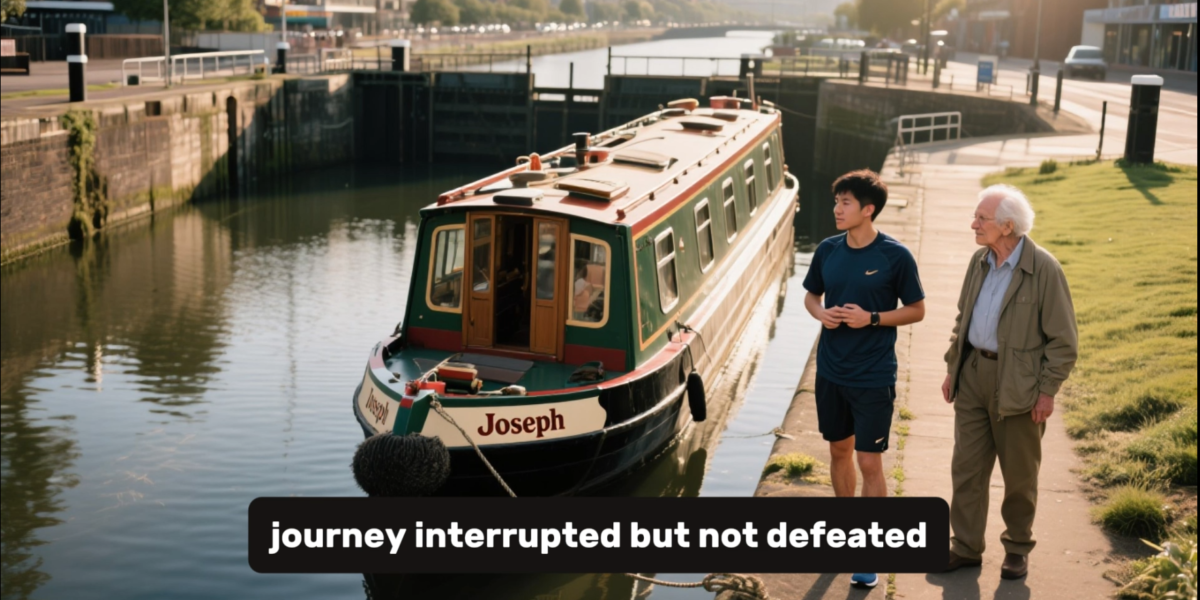
The scene that unfolded before me was quintessentially British in its quiet drama. There, beside the towpath near Farmer’s Bridge, sat a traditional narrowboat—her grey hull trimmed with classic red and white livery, her name Joseph proudly displayed in raised white letters on her side. The registration number, “Watford Nº 60628,” spoke of her official pedigree in the historic fleet of Britain’s inland waterways.
But Joseph was in distress. Her engine, succumbing to the strain of pushing 30 tons of steel through the water, had overheated and failed. And standing beside her, looking at once concerned and philosophical, were her owners: Mrs. Linda Scothern and Mr. Graham Scothern, a couple whose ages might have suggested they’d be seeking assistance, not attempting to manually navigate one of England’s most challenging flight of locks.
What struck me immediately wasn’t the predicament itself—engine troubles are part and parcel of narrowboat life—but rather the calm determination in the Scotherns’ faces. Here was a couple who embodied the spirit of the canals: self-sufficient, resourceful, and utterly unfazed by adversity.
“Could use a hand, if you’re willing,” Graham called out, his voice carrying the distinctive cadence of someone who’d spent years on the water.
Without hesitation, I stopped my run.
Reviving a Victorian Tradition
What followed was an experience that transported me—and anyone who stopped to watch—back to the Victorian era, when horses walked these very towpaths, hauling narrowboats laden with coal, pottery, and all manner of goods that built an empire.
We were about to attempt something rarely seen in the 21st century: manually hauling a 30-ton narrowboat approximately one kilometer uphill through the Farmer’s Bridge flight of locks. No horse. No engine. Just human muscle, determination, and the kind of community spirit that the Industrial Revolution was built upon.
Linda and Graham took charge of the locks—a job requiring precision, strength, and intimate knowledge of the canal system. As they worked the windlasses (the distinctive L-shaped cranks used to open and close lock gates), opening and closing the massive wooden gates, and carefully controlling the flow of water to raise and lower the level in each chamber, I took up position on the towpath with the tow rope.
The narrowboat’s traditional design suddenly revealed its genius. The curved lines, the low profile, the careful weight distribution—all of it engineered for exactly this kind of human-powered propulsion. As I leaned into the rope, feeling the initial resistance of Joseph’s mass, the boat began to move, inch by inch, then foot by foot.
A Moving Theater of History
What began as a simple act of assistance transformed into something remarkable—a living museum, a performance of sorts, that drew spectators from along the canal.
Joggers stopped mid-stride. Café patrons wandered over from the nearby Cambrian Wharf. Residents emerged from converted warehouse apartments, cameras in hand. Children on their way to school paused, wide-eyed, to watch this anachronistic scene unfold.
“Is that how they used to do it?” a young boy asked his father.
“Exactly like that,” the father replied, his own voice tinged with wonder.
As we progressed from lock to lock, Graham shared stories of canal life—of the “Number Ones” (independent boat operators who worked alone or as families), of the decorated water cans and intricate “roses and castles” artwork that adorned traditional narrowboats, of a time when the canal system was Britain’s motorway, moving goods from Birmingham to London, from Manchester to Liverpool, from the heart of the Industrial Revolution to the ports that connected it to the world.
Linda, meanwhile, worked the locks with practiced efficiency, each movement economical and precise. Between locks, she’d share cups of tea with curious onlookers, explaining the mechanics of the lock system, the lifestyle of continuous cruising, and why, despite the occasional engine failure, they wouldn’t trade their life on the water for anything.
“It’s slower,” she admitted with a smile that suggested she’d given this explanation many times before. “But slower doesn’t mean lesser. Slower means you actually see things. You talk to people. You’re part of where you are, not just passing through.”
The Physics of Community
There’s a particular kind of meditation that comes from sustained physical effort—a rhythm that develops, a zone one enters. As I pulled Joseph through each lock, feeling the burn in my shoulders and legs (a very different sensation from my usual 12K run), I found myself reflecting on the peculiar mathematics of helping others.
Here I was, giving my time and strength to two people I’d met moments before. And yet, I was receiving far more than I was giving. Every lock brought new conversations. A cyclist stopped to help push open a particularly stubborn gate. A woman walking her dog shared stories of her own grandfather, who’d worked the canals in the 1950s. An elderly gentleman in a flat cap simply watched, silent tears streaming down his face—seeing, perhaps, memories of his own youth reflected in this unexpected scene.
This was community in its purest form—not the commodified version we’re sold through apps and platforms, but the real, messy, beautiful thing: strangers becoming friends through shared effort toward a common goal.
The Summit and the Scotch
After nearly an hour of hauling, cranking, waiting for locks to fill and empty, and navigating the intricate choreography required to move a boat through this Victorian engineering marvel, we reached our destination: Farmer’s Bridge Top Lock at Cambrian Wharf.
Joseph sat safely in the lock, her journey interrupted but not defeated. The engine would need proper attention, but for now, she was secure. The morning sun had climbed higher, warming the September air, and the urban landscape of Birmingham stretched around us—a city that had grown up around these canals, that owed its historical prosperity to the very waterways we’d just navigated.
Graham secured the boat, his movements automatic after decades of practice. Linda disappeared below deck, returning moments later with three glasses—two containing generous measures of scotch whisky, and one filled with cool, clear water.
“To new friends,” Graham said, raising his glass. “And old ways of doing things.”
“To helping hands,” Linda added, her eyes reflecting genuine warmth. “And to people who still remember that we’re all in this together.”
We sat on the stern deck of Joseph, our legs dangling over the side, and talked. About life on the canals, about the changing face of Britain, about the value of slowing down in a world obsessed with speed. About the communities that form among continuous cruisers—people who’ve chosen to make Britain’s 2,000 miles of canals their permanent, mobile home.
The scotch mellowed them further (I happily sipped my water—I’ve never been a drinker, but I’ve always appreciated the rituals around it), and the stories flowed. Tales of narrow escapes in storms, of kindness from strangers in remote moorings, of the time Joseph’s predecessor ran aground in the Hatton flight, of the family of ducks that returned each spring to nest on their roof.
Reflections on the Water
As I eventually rose to continue my interrupted jog, completing the remaining kilometers of my daily routine, I found my mind returning again and again to those hours with Linda, Graham, and Joseph.
In our modern world, efficiency is prized above almost everything else. We optimize our routes, automate our tasks, and measure our productivity in outputs per hour. The canal system, by contrast, operates on principles that seem almost radical in their defiance of contemporary values: you move at four miles per hour, maximum. You stop for every lock. You moor where you can find space, not where it’s most convenient. You talk to everyone you meet because everyone is both neighbor and fellow traveler.
The narrowboat community represents something increasingly rare—a subculture that has actively rejected the pace and priorities of mainstream modern life in favor of something slower, simpler, and arguably richer. These aren’t people who’ve failed to adapt to the 21st century; they’re people who’ve looked at the 21st century and decided that the 19th century had some things right.
There’s a romance to it, certainly—the painted water cans, the brass fittings polished to a mirror shine, the coal-fired stoves that warm the narrow cabins. But there’s also a pragmatism, even a radicalism. Living on a narrowboat means living within strict constraints: limited space forces you to carefully consider what you truly need; limited water makes you conscious of every drop; limited electricity makes you appreciate light and warmth; limited mobility makes you appreciate where you are, not where you might be.
The Enduring Legacy of Britain’s Canals
The canal system that Linda and Graham call home is itself a testament to human ambition and ingenuity. Built during the Canal Mania of the late 18th and early 19th centuries, Britain’s inland waterways represent one of the greatest infrastructure projects in human history—thousands of miles of artificial rivers, carved by hand, linking every major industrial center in the nation.
The Birmingham Canal Navigations alone, where our morning adventure took place, comprise over 100 miles of canals—more than Venice, earning Birmingham the title of “City of Canals,” though few people know it. The Farmer’s Bridge flight, where Joseph met her temporary setback, consists of 13 locks raising and lowering boats 80 feet over less than a mile—a staircase of water climbing through the heart of the city.
These canals built Britain’s industrial might. Coal from the Midlands, pottery from Staffordshire, textiles from Manchester, iron from the Black Country—all of it moved on narrowboats like Joseph, pulled by horses walking the very towpath where I’d been jogging that morning.
When railways arrived, the canals declined. By the mid-20th century, most commercial traffic had ceased, and many canals fell into disrepair. But then something unexpected happened: people like Linda and Graham discovered them. Not as commercial highways, but as something else entirely—linear parks, wildlife corridors, floating neighborhoods, and thoroughfares for a different kind of journey altogether.
The Mathematics of a Life Well-Lived
As I reflect on that September morning—now years in the past, but vivid as yesterday in my memory—I find myself thinking about the metrics by which we measure our lives.
That day was my 345th consecutive 12-kilometer run. I was proud of that number—it represented discipline, commitment, the achievement of a goal. But what I remember isn’t the distance or the number. What I remember is Linda’s laugh as she told a story about a swan that had taken offense to Joseph’s passing. Graham’s hands, weathered and strong, demonstrating the proper way to throw a mooring line. The weight of the tow rope in my hands. The collective cheer from the small crowd that had gathered when we finally reached the top lock. The taste of cool water after hard work. The warmth of spontaneous friendship.
In our data-driven age, we’re constantly counting: steps walked, calories burned, likes received, messages sent. But the things that matter most resist quantification. How do you measure the value of an unexpected conversation? How do you count the worth of helping a stranger? How do you calculate the significance of a morning that changed your perspective on what it means to live well?
A Message from the Water
If there’s a lesson in the story of Joseph and that September morning, perhaps it’s this: life’s most meaningful moments are often interruptions to our planned routines. I was focused on completing my 345th run, on maintaining my streak, on hitting my numbers. What I got instead was something far more valuable—a reminder that we are, at our best, communal creatures; that the old ways of doing things sometimes worked because they forced us to interact, to depend on each other, to share our strengths and acknowledge our vulnerabilities.
The narrowboat community understands something we’ve largely forgotten: that the journey is the destination, that the people you meet along the way are the point, that moving slowly enough to wave to everyone you pass isn’t a bug in the system—it’s the feature.
Linda and Graham, wherever Joseph has carried them in the years since that morning, embody a kind of quiet resistance to the hecticness of modern life. They’ve chosen a different pace, different priorities, different measures of success. And in doing so, they’ve created a life rich in exactly the things our faster, more efficient world seems to lack: time for conversation, space for spontaneity, and an openness to the kindness of strangers.
The Continuing Voyage
The last I saw of Joseph that morning, she was safely moored at Cambrian Wharf, waiting for her engine to be repaired. Linda and Graham waved as I finally set off to complete my run, their silhouettes framed against the modern city that had grown up around the historic canal.
I’ve often wondered where Joseph is now—whether she’s moored in a quiet rural spot, whether she’s navigating the Shropshire Union, whether she’s hosting Graham and Linda’s grandchildren for a weekend adventure. I like to think that somewhere on Britain’s waterways, she’s still gliding along at four miles per hour, still bringing people together, still carrying forward the traditions of a slower, more connected way of life.
And perhaps somewhere, another jogger is stopping mid-run to help a stranger with a broken-down boat, learning the same lessons I learned that bright September morning: that helping doesn’t diminish you—it enriches you; that old-fashioned doesn’t mean obsolete; and that sometimes the best thing you can do with your carefully planned day is to throw the plan away and pull a 30-ton boat through a flight of locks.
Because at the end of our lives, we won’t remember our longest streaks or our highest numbers. We’ll remember the people we met, the stories we shared, and the mornings when everything went wrong and somehow turned out exactly right.
Joseph—and Linda and Graham, her devoted crew—taught me that. And I’ll be forever grateful for the lesson.The author continues to jog along Britain’s canals and remains ready to help anyone whose engine has inconveniently overheated.